coming events:
lecture on basic concepts of Root Shinto: tram-ʔat and kam-ʔw-ʔy
24.09.2013 Tuesday at 6 am SLT
pon Little Yoshiwara sim
ラベル lectures on Japanese history in Second Life の投稿を表示しています。 すべての投稿を表示
ラベル lectures on Japanese history in Second Life の投稿を表示しています。 すべての投稿を表示
2013年9月17日火曜日

2012年8月2日木曜日
Buddhism and kanji: two main borrowings of Kofun
02. 08. 2012
Last time we spoke of technical borrowings of Kofun. Today I would like to speak of two main intellectual borrowings of Kofun period:
Last time we spoke of technical borrowings of Kofun. Today I would like to speak of two main intellectual borrowings of Kofun period:
Buddhism and Chinese writing system.
According to Japanese chronicle Nihonshoki in 522 king
(wan) of Baekje

Songmyong sent his subject Norisa Chige with the following
gifts: a statue of Buddha some banners and sutras.
Norisa Chige also brought a letter of his king where
king of Baekje wrote that doctrine of Buddhism is a beautiful almighty magical mean
accepted by all states from distant India to three states of Korea.
Kimmei tenno didn’t want to decide himself about this
new belief so he let people of three most mighty clans (Soga, Mononobe,
Nakatomi) decide themselves about this new belief.
Soga decided that if all other states revere Buddha
the state of Yamato also was to do the same. But Mononobe and Nakatomi said
that if they set a cult of a new kami (Buddha) local traditional kami could be
offended.
After all Kimmei tenno said: “Let the statue of Buddha
will be given to that who desires it and let he tries to revere it”.
Soon after Soga clan began to revere Buddha happened
some epidemic diseases and Mononobe and Nakatomi decided that it happened due
to the new cult and threw statue of Buddha of Soga temple to the Naniwa
channel.
But Soga clan continued to revere Buddha and slowly
Buddhism spread.
The main point here is the following: in 5 – 6 centuries
there were some clans of high nobility who were believed to originated from kami
for instance Nakatomi were supposed to originate from Ame no Koyane no mikoto,
Mononobe from Nigi Hayahi no mikotob while Soga had no kami among ancestors, Soga
originated from Takuichi no Sukune a real person who was a successful militant
famous by his actions against so called “eastern barbarians”. Thus it is quite
obvious that Soga wanted to raise prestige of their clan.
It is important to note that tenno clan also was
interested in Buddhism cause Buddhism could be the base to unify interests of
different clans while traditional cults (Shinto) could not and instead were
good base for centrifugal tendencies.
Actually practically all groups were interested in
Buddhism cause they could get some profit from it.
First Buddhism was accepted outwardly without
understanding of its meaning, i.e. Buddha was considered just as one of mighty
kamuy/kami. And only a while later they started to grasp its real meaning.
But I am to tell that since the very beginning
Buddhism influenced to the Japanese culture. The main influence of Buddhism in
Japan is spread of Chinese writing system – kanji – Chinese signs.
All sutras were written in Chinese. To read them they
were to know Old Chinese or Wen Yan. Then they started to write original texts
in Chinese. It is important to note that hieroglyphs were convenient to
expression of Chinese language where words consisted usually of one syllable
but were not convenient for Japanese where words could consist of many
syllables.
So first Japanese wrote in Chinese then somebody
invented to use Chinese sings as signs for syllables: 多太 tada, 安佐 asa such way of writing
was called Man’yogana cause it was used in poetry anthology Manyoushuu
Since man’yogana they began to elaborate a standard
set of syllabary signs which resulted as katakana and hiragana.
Here are picture representing the development of signs
of katakana and hiragana from certain Chinese signs:


And finally we got kana kanji majiri bun: a system
where unchangeable part of word is written by kanji while changeable is written
by kana.
Kofun period
26.07.2012


Today I
would like to speak of Kofun period
Kofun is is
an era in the history of Japan from around 250 to 538
Kofun 古墳 means ‘ancient grave’. The period
is named Kofun cause its characteristic features is burial mounds.
The kofun
graves have assumed various shapes throughout history.

The most common type of kofun is known as a zempō-kōen-fun (前方後円墳, which is

shaped like a keyhole, having one square end and one circular end, when viewed from above.

The most common type of kofun is known as a zempō-kōen-fun (前方後円墳, which is

shaped like a keyhole, having one square end and one circular end, when viewed from above.
There are
also circular-typed empun 円墳, "two conjoined
rectangles" typed zempō-kōhō-fun 前方後方墳, and square-typed hōfun 方墳kofun (look at the first picture)
Also kofun
often were arranged with ditches.
Orientation
of kofun is not specified. Kofun range from several meters to over 400m long.
The largest, which has been attributed to legendary Nintoku emperor, is Daisen
kofun in Sakai City, Osaka Prefecture:

Haniwa (lit.: clay ring) figures, were arrayed above
 and in the
surroundings to delimit and protect the sacred areas.
and in the
surroundings to delimit and protect the sacred areas.

Haniwa (lit.: clay ring) figures, were arrayed above

Here are
some pictures of haniwa


Also there is a thought that haniwa could be substitutes of human
sacrifice. This thought is based on a legend of Kojiki/Nihon shoki describing
the rule of legendary emperor emperor
Suinin 垂仁天皇 who set practices of haniwa instead of burial of servants and slaves.
Kofun is obviously Korean influence. Burial mounds of
Japan are just development of those of Goguryeo.


it is especially
well seen in mural paint:
Korean:

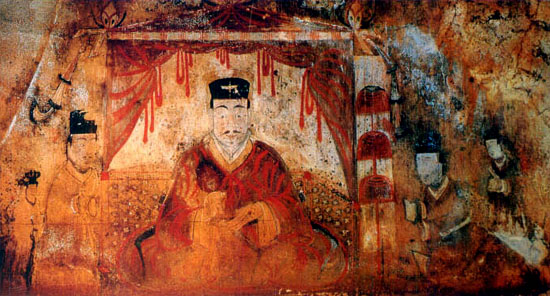
Kofun:
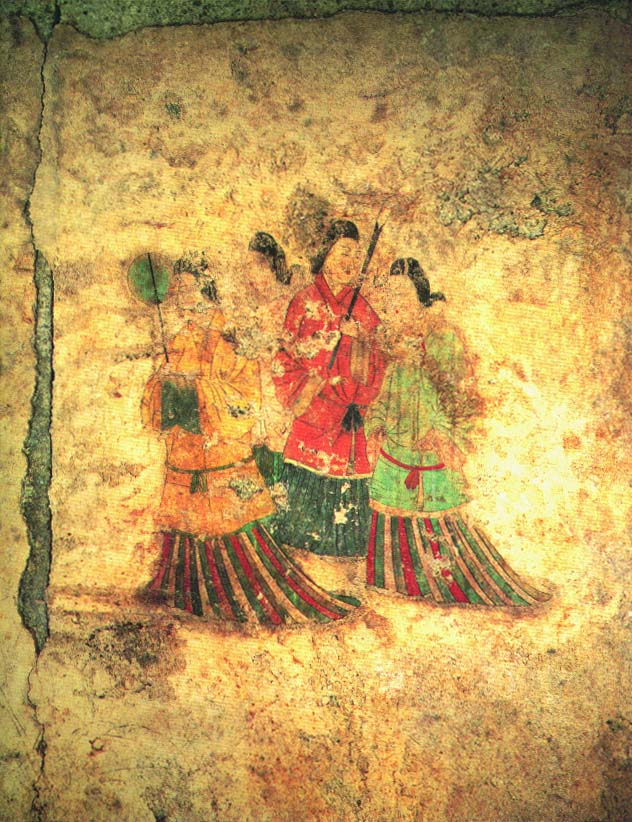
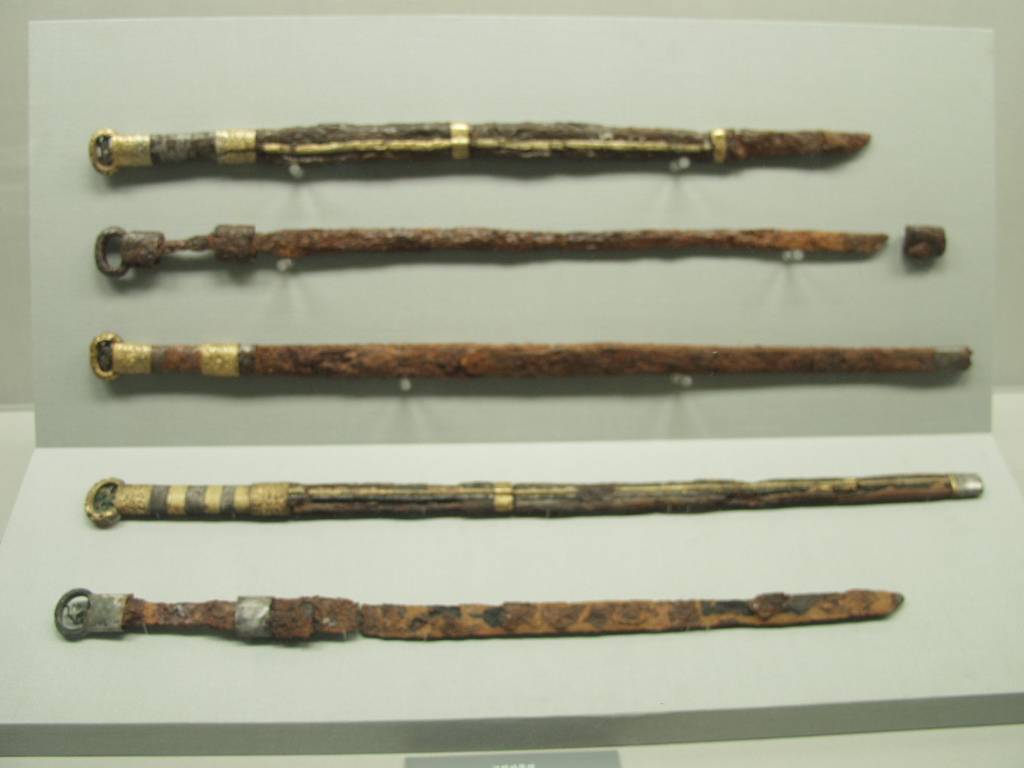
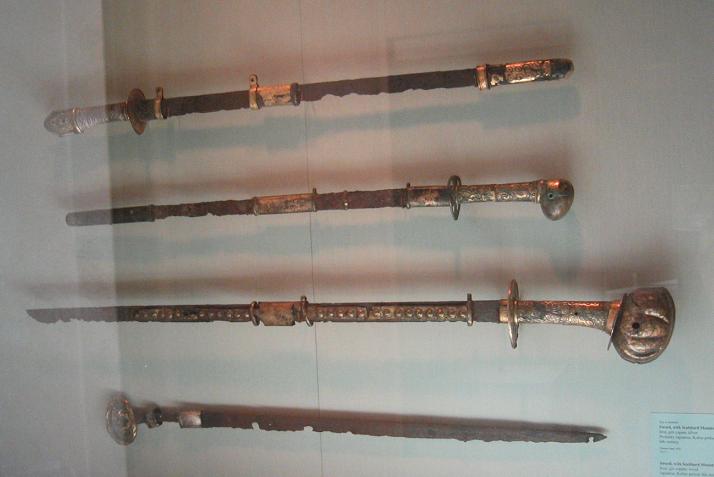
Things
found in Kofun sites are obviously of Korean origin:
Swords:
Korean:

Kofun:

personal armor

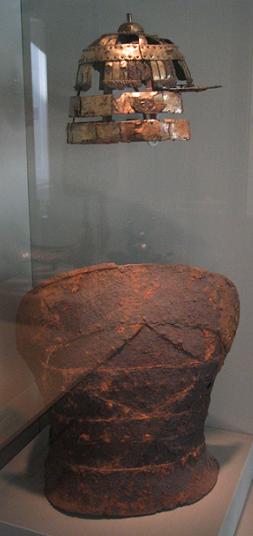
A
reconstruction of male clothes:


A
reconstruction of female clothes:


History of Languages of Japan
19.07.2012


Because of it we have to pay most attention to structures in any linguistic question but especially while we deal with questions of genetic relationship.
What parameters should be the matter of research is a separated question but the fact that structures/grammar is much more important than lexis is the basement.
After the detecting of structural similarities we should of course find material similarities of exponents.
These two points i.e. structural similarities and material similarities of exponents seem to be necessary and enough to make a conclusion about genetic relationship.
Comparison of lexicon can't be proof of genetic relationship of languages. Still Swadesh himself warned against it. Moreover the term of "basic lexicon" is very questionable 'cause the whole of lexicon is culturally determined as it was shown by Hoyer.
Indefinite forms:
Past tense:
Today I
would like to speak of languages of Japan
Here are
maps which represent the history of spread of different languages of Japan:


well
First
language spoken pon Japanese islands was Ainu (here I use term Ainu just as a
convenient short term to denote Ainu stock in general; as well are “Korean” and
“Austronesian”).
why they decided
that language of Jomon was of Ainu stock? As I said in previous talks there are
firm proves of the fact that Jomon people were direct ancestors of Ainu:
anthropological
similarities of contemporary Ainu/Okinawan and Jomon people, Jomon people
existed in almost the same territory where Ainu exist now, many toponyms of
definitely Ainu origin (words consisted of Ainu roots and which can be clear
interpreted through Ainu language) were found there where never lived so called
“historical Ainu”.
When we
find many localities where site of Jomon epoch exist bearing names traceable to
Ainu roots, we can only assume that persons using the same language as the Ainu
were formerly established in such places.
Ainu
language is considered as an isolated by contemporary linguistics. Ainu
language differ radically from neighboor languages: Japanese, Korean, Nivkh,
Itelmen, Chinese, Tungusic languages and Austronesian languages.
Almost all of
Ainu language genetic relationship hypotheses were made with no care of
structure differences of compared languages but just on the base of coincident
similarities of some random lexemes so it is possible to state that research of
Ainu language in connection to its genetic relationship is in the very
beginning.
There are some
hypotheses trace Ainu to some stock of South-East Asia. One of the most
interesting is that of Alexander Vovin. Despite of lack attention paid to the structures of
compared languages and some serious mistakes of general kind his attempt is
very interesting and profound and is worth paid attention to.
By the
comparison lexis of contemporary Ainu dialects he made a reconstruction of so
called Proto-Ainu. Actually it’s not Proto but Upper-Jomon/Late Jomon language.
It was supposedly spoken in late Jomon (about 1000 – 500BC) Well, so he made a
reconstruction of phonology of that language and then compare it with
phonological systems of different SEA stocks: Hmong-Mien, Proto-Austronesian (Austronesian
stock: Polynesian, Micronesian and so on) and Proto-Austroasiatic stock
(Mon-Khmer). And came to the conclusion that phonology system of Proto-Ainu is
very close to that of Proto-Mon-Khmer, i.e. he stated that Ainu and Khmer are
distant relatives.
The main
critical note is that Vovin pays no attention to structural aspects. Ainu
language may be a distant relative of a certain language of a certain SEA
languages but should be shown more serious prooves of it, not only phonological
and lexical similarities. Should be shown structural similarities such as similarity of type of
linear model of word form, similarity of structure of verb paradigm. cause
language is not a heap of lexemes but is first of all a system of structures. So considering any linguistic
question we are to pay most attention to the structure but not to lexis or
phonology.
Each language is first of
all a structure but not just a heap of lexemes.Because of it we have to pay most attention to structures in any linguistic question but especially while we deal with questions of genetic relationship.
What parameters should be the matter of research is a separated question but the fact that structures/grammar is much more important than lexis is the basement.
After the detecting of structural similarities we should of course find material similarities of exponents.
These two points i.e. structural similarities and material similarities of exponents seem to be necessary and enough to make a conclusion about genetic relationship.
Comparison of lexicon can't be proof of genetic relationship of languages. Still Swadesh himself warned against it. Moreover the term of "basic lexicon" is very questionable 'cause the whole of lexicon is culturally determined as it was shown by Hoyer.
When I
tried to make some reconstruction by myself I made some similar conclusion on
Upper Jomon Ainu as Vovin did and I also I concluded that Upper Jomon Ainu
differed much from the contemporary one. I think that structure of ancient Ainu
was quite similar to that of SEA languages: morpheme is equal to a syllable,
auxiliaries could be placed on nuclear position as well.
Here I
would like to show an example of how it possibly could sounds alike:
Nga Res han
I am Tresi
Ta han pe nga
set han
This is is
my house
(actually
these examples a just a kinda conlang made after the facts of
reconstruction: it was made just to show
how it could be while real reconstruction is in process)
But under
the influence of Korean/Old Japanese ancient Ainu got morphology. I guess that Condition of permanent stress
and war cause the necessity of more economy use of speech. i.e.: make sentence
shorter and express more information in the same piece of speech, express it
more exactly, express all important facts in verb stem, thus appeared
morphology and so in modern Ainu we have:
Tres ku=ne
I am Tresi
And
Tampe
ku=cise ne
This is my
house
As it is
seen in maps
Japanese is
a relative of Korean (more exactly a descendant of Old Korean)
They have very similar
structure of sentence
SOV
And very similar structure
of word-form
(p)+( r ) + R + ( s )
Prefixation ain’t developed
well in Japanese as well as in Korean and most meanings are expressed by
suffixation
When we speak of comparison
of language we are to pay most attention to verbal structure cause verb is
spine of any language and in
verbal structures the most interesting and significant are way of expression of
tenses modality and so on. And in the case of Korean and Japanese we see the
following:
Indefinite forms:
Suru – hada – to do
Kuru “to come” – kada – “to
go”
Sumu – salda – to live
Past tense:
Sita - Hetta/haetta –
did/made
Kita – katta – came/went
(left form is Japanese and right is Korean)
(left form is Japanese and right is Korean)
Mul – midu -water
maɯl – mura – village
mwe – yama – mount
nun mul – na-mida - tear
(left is Korean and right is Japanese)
(left is Korean and right is Japanese)
Numerals of Old Japanese (left) and Goguryeo (right)
Mi mit 3
Itu utu 5
Nana nanɯm 7
Towo tok 10
Roots of Shintō
05.07.2012
Today i would like to speak of roots of Shintō/root Shintō.
First it is important to note that term Shintō should be revised because it is just an arctificial term invented in Heian period in order to distinguish local autochtonic beliefs from Buddhism and Taoism.


It is not possible now to say where from exactly Ainu came to the Japanese erchipelago (But there are some obvious facts that tell us that Ainu came from South for example the fact that Jomon culture began its spread from the south of Japanese archipelago. But it is well known that they settled all over archipelago from southern Ryukyu till Hokkaido and also Kuril islands and southern half of Sakhalin and southern end of Kamchatka.

Toponyms of Ainu origin corroborate this fact, for example: Tsushima <- Ainu.: tuyma – "distant", Fuji <- Ainu: huci – "grandma", "kamuy of fireplace"; Tsukuba <- Ainu: tu ku pa – "head of two bows", Yamatai <- Ainu: ya ma ta i - «place where harbour deeply cuts the land".
When beings die or when things are broken their ramat leaves them but doesn't disappear and goes to another place.


Some researchers, for example W.Aston, J. B. Sansom incorrectly interpreted gohei and nawa as development of sacrifice of phloem, hemp and dresses while under the influence of Ainu inaw which were substitutes even in Ainu culture, sacrifices got a form of gohei and nawa.
Today i would like to speak of roots of Shintō/root Shintō.
First it is important to note that term Shintō should be revised because it is just an arctificial term invented in Heian period in order to distinguish local autochtonic beliefs from Buddhism and Taoism.
This term
was invented according to Chinese samples: in Chinese culture there are many
doctrines, each of which is called as "a way something".
As far as
Chinese culture is culture of written signs, many doctrines and concepts can be
pretty fully expressed in written signs and through them gradually can be
pretty fully acquired.
Due to this
gradually acquire appears the analogy of "way", i.e. gradually moving
to a certain aim.
Actually Shintō
is not a "way", it is not a systematic religion but just a heap
of rather amorphous so called "atmospheric
cults".
However, it is possible to single out some basic concepts which are
common for all traditions belonging to Shintō.
These basic
concepts are: tamashii/tama 魂 “vital energy”/”soul energy” and kami 神 “a super human being”.
Tamashii penetrates by the whole world and
fills everything, fills all beings and all things. All beings and things are
endowed tamashii in different degree: some have a lot of tamashii but some have little.
It is good to have a lot of tama. More tamashii
you have more mighty you are. Kami have a lot of tamashii and can endow
tamashii 魂 or take
it away.
Therefore the purpose of any rite of
Shintō is to save present tamashii and
get it more: in order to save present tamashii and get
more it is need to contact with kami.
Both of
these concepts (tamashii and kami) are traced back to Ainu concepts ramat –
“soul exists” and kamuy “super human being”.
Ainu are
the most ancient population of Japanese archipelago, Kuril islands, Sakhalin
and Kamchatka peninsula.


From the
point of view of physical anthropology Ainu have no similarities with any
population of Asia and Pasific Rim except people of Japanese Neolithic culture
or so called "Jomon culture" (about 13000 BC till about 500 BC.)
Jomon is
Japanese calque of English term 'cord mark', 'cord marked pottery' which
describes a characteristic feature of the pottery of this archaeological
culture and on which this culture or a group of cultures was named.
Jomon
pottery is the oldest pottery of the world and one of the most beautiful also:

Situation
in historical linguistics is analogous of that of physical anthropology.
Ainu
language is considered as an isolated by contemporary linguistics. Ainu
language differ radically from neighboor languages: Japanese, Korean, Nivkh,
Itelmen, Chinese, Tungusic languages and Austronesian languages.
It is not possible now to say where from exactly Ainu came to the Japanese erchipelago (But there are some obvious facts that tell us that Ainu came from South for example the fact that Jomon culture began its spread from the south of Japanese archipelago. But it is well known that they settled all over archipelago from southern Ryukyu till Hokkaido and also Kuril islands and southern half of Sakhalin and southern end of Kamchatka.

Toponyms of Ainu origin corroborate this fact, for example: Tsushima <- Ainu.: tuyma – "distant", Fuji <- Ainu: huci – "grandma", "kamuy of fireplace"; Tsukuba <- Ainu: tu ku pa – "head of two bows", Yamatai <- Ainu: ya ma ta i - «place where harbour deeply cuts the land".
Also many
examples of Ainu toponyms can be found in Kindaichi Kyousuke works.
Later, when
so called Old Korean came Ainu were one of the main component of forming
Japanese ethnicity. Research of DNA of Japanese population showed that most
widely spread Y-japlogroup is D2 which is main Ainu Y-haplogroup (about 86% of
Ainu have it).
The most
notable fact is that Japanese and Korean have similar mtDNA while Korean have
practically no Y-DNA D2. (The Japanese are basically mix of ancient Ainu and
ancient Korean) That means that Ainu took Korean women but not vice versa. This
fact tells us that the rulers were Ainu. Most of Japanese nobility is of Ainu
origin.
Also Ainu
influenced seriously on forming Japanese creed, i.e. Shintō.
It is
notable fact that Japanese terms tamashii/tama and kami sounds much alike Ainu
terms ramat and kamuy and also expresses practically the same concepts:
Explaining
the meaning of this concept of ramat Neil Gordon Munro quotes the explanations
that he received from Ainu elders (ekasi): "KotanPira said ramat was
the backbone of Ainu religion.
Rennuikesh,
eighty years old, very active and intelligent, who came from the north of
Hokkaido, said: 'Whatever has no ramat has nothing'. Nisukrek and other elders
agreed with this: 'ramat is all-pervading and indestructible'.
Word ramat
consists of two morphemes: ram which means
"soul"/"mind"/"heart" and at which is similar to
such verbs as an/oka and oma which mean "to be"/"to
exist". So it can be interpreted as "soul exists"/"vital energy
exist".
(It is notable fact that many verbs of Ainu
language designating mental activity, are formed with ram root: ram
– to "think", e-ram-an – to "understand", e-ram-iskar
– "not to understand", e-ram-as – “to rejoice to something”)
Following
to Neil Gordon Munro it is possible to state that ramat is very much
alike to the Polynesian mana.
Every thing
and every being has ramat. One thing has a lot of ramat another
has little but nothing can exist without ramat. Ramat cannot be
annihilated.
When beings die or when things are broken their ramat leaves them but doesn't disappear and goes to another place.
So we can
see that features of ramat are very close to that of tama.
Also it is
interesting to note that tamashii/tama originated from the word ramat by its
sound:
In Ainu
language [ ɾ ] can easily become [ tɾ
] [ tl ][ dl ] [ t ] [ d ] [ l ]. In Old Japanese initial r was prohibited and
also there were no consonant claster and close syllables so Ainu word ramat
could become only tama/tamatV/tamasV in Old Japanese.
(Here sign
"V" means an unidentified vowel sound.)
As for
kamuy here there are some versions of etymology but following to John Batchelor
I think word kamuy consists of three morphemes: ka + mu
+ i and interpreted its meaning as 'something over us" or a
"super human being".
It should
be noted that concept kamuy differs seriously from European concepts
deus / god / Gott / dios / deux because European god (God of christianity) is a
transcendental being opposite to this world while kamuy exists in the
neighborhood of people and people can easily get kamuy mosir (island of
kamuy) and also people can become kamuy.
Because of
it, the word kamuy should not be translated as dew /god / Gott / dios /
deux into European languages. I think the best way is to leave the word kamuy
without any translation at all and explain its meaning with a certain context.
And
etymology of Japanese kami is the following: Old Ainu (Upper Jomon Ainu) ka-mu-'i
[kamuj] -> Old Japanese kamɯ -> Modern Japanese kami.
Meaning kami is completely the same as meaning of kamuy.
Kamuy has a lot of ramat and can
endow or take away ramat to other beings. Kamuy which endow ramat
are good, kamuy which take ramat away are bad.
Every event
of Ainu traditional life can be described in terms of ramat and kamuy. Any act
of Ainu tradition is intended to save and to magnify the existing ramat.
Because of it a thing which has much ramat and which can magnify ramat
is good thing; while thing which takes ramat away is bad.
Best way to
get more ramat is to communicate with kamuy. To communicate with kamuy we need
a special artifact – inaw – literary i-naw means "shaved",
"curled". Inaw A baton with savings

It is considered as an universal
pure thing for storage, getting or transfer ramat.
Having
offered inaw we set a cahnnel between our island/world and island/world of
kamuy. And by this channel ramat of kamuy flows to us.
The origin
of inaw is unclear, but there are ideas that it could origin from dogū - clay figurines of Jomon epoch of unknown means:

These
figurines are considered as substitutes of human sacrifice by some
anthropologists and inaw as they are development of dogū
have the same function.
But more
notable fact it that in shintō exist the same items as inaw. I
mean gohei 御幣 and and seminawa (締縄 or 標縄) or just nawa
縄 (word nawa itself seems to
originate from Ainu word naw/i-naw).


Some researchers, for example W.Aston, J. B. Sansom incorrectly interpreted gohei and nawa as development of sacrifice of phloem, hemp and dresses while under the influence of Ainu inaw which were substitutes even in Ainu culture, sacrifices got a form of gohei and nawa.
Japanese mechanically reproduced remotely an anthropomorphous form inaw,
without understanding its real content. Only this can explain why substitutes
of fabrics have the form, reminding substitutes of human sacrifices.
Thus we
have the following: tama/ramat is a clot of "living" a
concentration of spiritual energy or even just general energy. Tama/ramat
penetrates by the whole world and fills everything, fills all beings and all
things.
All beings
and things are endowed tama/ramat in different degree: some have a lot
of tama/ramat but some have little. More tama you have more mighty you
are. It is good to have a lot of tama.
Therefore
the purpose of any rite of Shintō/Ainu traditional creed is to save present tama/ramat
and get more.
Kami/kamuy is everything that has a lot of tama/ramat
and can endow tama other beings.
Kami/kamuy is all outstanding and
unusual, somehow, for example: thousand-year cedar, stone of a freakish form,
falls, mountain of Fuji, founder of the Panasonic company, emperor Meiji, master
of a calligraphy or, for example, famous musician or writer.
It is very
important to understand that often kami /kamuy is not any
personal/anthropomorphous being or a subject or a thing which can be presented,
touched or, in general, be felt by means of five feelings.
Much more
often kami /kamuy is certain amorphous force, for example, force of an
attraction of Earth to the Sun also is a kami/kamuy, forces operating in
an atomic nucleus between protons and neutrons also are kami/kamuy, and
other similar phenomena also are kami/kamuy.
The purpose of any rite of Shintō is
to save present tama/ramat and
get it more: in order to save present tama/ramat and get
more it is need to contact with kami/kamuy.
Does anybody have any questions?
Early history of Japan
12.07.2012
Hello


Toponyms of Ainu origin corroborate this fact, for example: Tsushima <- Ainu.: tuyma – "distant", Fuji <- Ainu: huci – "grandma", "kamuy of fireplace"; Tsukuba <- Ainu: tu ku pa – "head of two bows", Yamatai <- Ainu: ya ma ta i – “place where harbour deeply cuts the land”, many examples of Ainu toponyms can be found in Kindaichi Kyousuke works.
When Ainu moved northward they influenced strongly on the culture of Nivkh, Itelmen and Oroch. This fact had been reflected by language: for example: Ainu word kotan – "settlement", "inhabited area" exists in Old Mongolian as gotan, in the language of Gold – hoton, in Manchurian language – hotan, in Nivkh language – hoton.


The most probable place where Yamatai state could be is a harbour in the mouth of Chikugo river near of the town with the same name (i.e. Yamato) in Fukuoka prefecture in the island of Kyushu.


On the other hand, the evidence of warfare during the Yayoi Period is quite clear. Defencive settlements appeared, which were surrounded by either moats of defensive walls or which were located on the hilltops characterized by poor productivity but by excellent command of view.
...Archaeologistss have also discovered many Yayoi Period tombs for the victims against whom such homicide tools were used or those un which such homicide tools were buried with the bodies...”
But how it could be? From a common point of view Japanese culture has practically no similarities with Ainu culture. (Though as it will be shown in special text the roots of Japanese culture are of Ainu origin) Japanese speak Japanese language but not Ainu. Below I try to explain how it could be.
When in the beginning of Yayoi epoch in Japanese archipelago started to appear first groups of Korean newcomers the archipelago is completely occupied by Ainu and there are almost no free territories and no newcomers are desirable. There are some groups of Ainu, some principalities which wage war between each other and safety of Korean newcomers is quite questionable.
The Ainu leader also has his interests: first, strangers with whom it is going to become related, brought such technologies, possessing which, he can subdue hostile Ainu groups almost without any efforts; besides, the fact of possession the foreign woman also will lift his prestige and prestige of his clan in eyes of another groups of Ainu.
Hello
Today I
would like to speak of early history of Japan
Mainly of
Jomon and Yayoi epoch
It’s
possible that we have not enough time to talk of all points so it this talk
probably gonna be continued
We can
speak of Japan as archipelago only since the end of last glacial period (about
13000 BC)
While
during glacial Japanese archipelago was connected with continent in the
following way:

In the time
of glacial first people of modern anthropology type came to this territory. These
people were direct ancestors of modern/historical Ainu and they set the culture
which later was named Jomon.
This archaeological culture
or a group of cultures existed in Japanese archipelago since about 13000 BC
till about 500 BC.)
Jomon is Japanese calque of English term 'cord mark', 'cord marked
pottery' which describes a characteristic feature of the pottery of this
archaeological culture and on which this culture or a group of cultures was
named.
Jomon pottery is the oldest pottery of the world and one of the most
beautiful also:


There were different types
of ceramics and the most interesting was made by the late of Jomon.
Among Jomon ceramic
artifacts the most interesting are so called dogū - clay figurines of unknown means:
some anthropologists suppose that these dogu can be substitutes of human sacrifice and
are somwhow realted to Ainu inaw http://tresi-nonno.blogspot.com/2012/06/basic-concepts-of-ainu-religion-and.html . Anyway it is possible to
state that they could have some relation to creeds of Jomon people.
The proves
of Ainu and Jomon people relationship are the following:
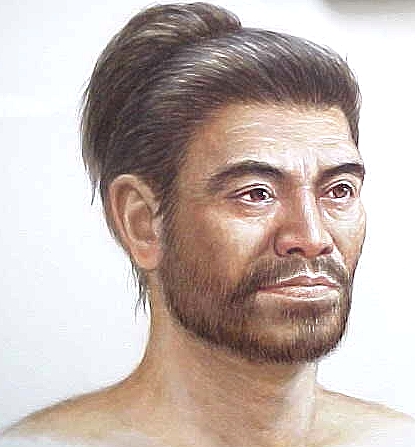
a reconstruction of Jomon
man (proves of the fact that people of Jomon were of Ainu origin are the
following: similarity of Ainu skulls and Jomon skulls:

then are
founded many localities where sites of Jomon epoch are found bearing names traceable to Ainu roots, we can
only assume that persons using the same language as the Ainu were formerly
established in such places. http://tresi-nonno.blogspot.com/2011/12/ainu-jomon-relationship-prooves-by-neil.html
(we should use term Jomon with certain degree
of awareness cause it is just a term invented to designate a complex of
archaeological cultures but later it was used by some Japanese anthropologists
in order to artificially distinguish Ainu culture from its roots)
People of
Jomon epoch were seagatherers, forest gatherers, fishers, forest hunters and
sea hunters and didn't practise agriculture so a vast space of wild nature was
a matter of high importance for existence of their culture.
(Basic
economical articles of Neolithic Ainu were gathering of shells and gathering of
chestnuts and nuts. Jomon archaeological culture is famous by its shellheaps.
And so Neolithic Ainu were basically closely connected with forests of
chestnuts and nuts which covered then most part of Japanese archipelago)
Thus people
of Jomon never had any big settlements, the biggest social unit was local group.
To maintain balance in nature and in
human population was matter of vital importance for such culture.
Because of
it they settled all over archipelago from southern Ryukyu till Hokkaido and
also Kuril islands and southern half of Sakhalin and southern end of Kamchatka:
Toponyms of Ainu origin corroborate this fact, for example: Tsushima <- Ainu.: tuyma – "distant", Fuji <- Ainu: huci – "grandma", "kamuy of fireplace"; Tsukuba <- Ainu: tu ku pa – "head of two bows", Yamatai <- Ainu: ya ma ta i – “place where harbour deeply cuts the land”, many examples of Ainu toponyms can be found in Kindaichi Kyousuke works.
About the
mid of Jomon period some groups of Austronesian people from South-East Asia
appeared in the southern part of Japanese archipelago.
(This group
is named austronesian with a certain degree of conventionalism because there
could be also some people of Yue and Hmong-Mien. And it is important to note
that we have little information of this group.)
This new
migration destroyed the balance of nature and some groups of Ainu were forced
to move northward/ Ainu migration to the island of Sakhalin, the islands of
Kuriles and Kamchatka began.
When Ainu moved northward they influenced strongly on the culture of Nivkh, Itelmen and Oroch. This fact had been reflected by language: for example: Ainu word kotan – "settlement", "inhabited area" exists in Old Mongolian as gotan, in the language of Gold – hoton, in Manchurian language – hotan, in Nivkh language – hoton.
Or, for
example, Ainu word inaw, designating little baton with shavings –
one of the most important objects of Ainu religion, exists in Nivkh language – nau,
in Oroch language – ilau.
In Itelmen
language exists word kamul designating spirits living in volcanoes and
geysers, I believe that this word originated from Ainu word kamuy –
“super human being”.
I think
that it is possible to speak about Ainu colonization because in Ainu language
exists original not borrowed word for expression of modality “should”, “must” –
easirki- “do to do first of all”
while such a languages as Nivkh,
Itelmen, Oroch use borrowed words to express this modality and originally have
just two modalities: “want” and “cannot”. Modality of “should” is a
marker of high organized social system.
While some
groups of Ainu were moving northward in the southern part of Japanese
archipelago appeared some ethnic groups from Korea.
These
migrants were of Mongoloid anthropological type and spoke an Altaic language.
First groups of this migration appeared in Japanese archipelago in the end of
Jomon and in the beginning of Yayoi epoch.
Comparison
of anthropological type of Jomon/Ainu and newcomers of Yayoi:


(Yayoi is archaeological culture which came in
the stead of Jomon. It is also named
after its ceramics which was named after teh place where it was found - Yayoi
district in Tokyo. Yayoi culture lasted from 500 BC till about 300 AD).
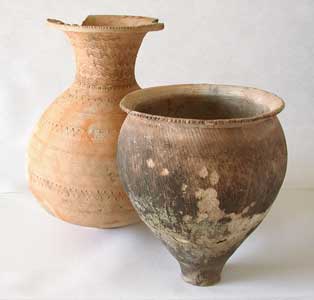
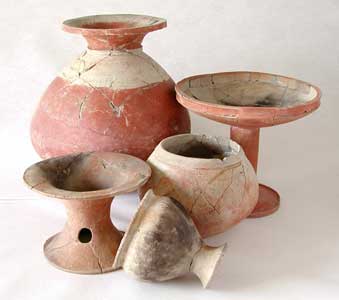
And the
last groups of these ancient Korean migrants appeared in the Japanese islands
in the very end of Yayoi and even in the beginning of the next period – Kofun –
“Burial mounds period”.
It is
generally supposed that this last group was the root of emperor kin tenno and
established Yamato state and that after the establish of Yamato began the epoch
of permanent war between Wajin(Japanese) and Emishi(Ainu). But reality
was a bit more difficult.
First, word Yamato obviously originated
from word Yamatai. (Yamatai is the most ancient state placed in the Japanese archipelago.
Yamatai state was described in Chinese chronicle "Wei Zhi".
Yamatai
state was described in Chinese chronicle "Wei Zhi". We are to note
that Wei Zhi is allocated against others Chinese text of this epoch: it has no
fantasy and it's very realistic, for example distance between Korean peninsula
and Yamatai is described very close to reality. "Wei Zhi" is jut a
diary of a traveller. And there are a lot of Ainu toponyms and names in it, for
example Pimiko queen of Yamatai is a name of Ainu origin, originally it was Pi
mik kur - Person who solves problems and barks)
Word
"Yamato" is written down by hieroglyfes as 大和 and according to the rules these
kanji should be read as 'dai wa' - 'great wa'. ("Great Wa" is the
name invented by Chinese to denote ancient Japan and it was used until term
Nihon was invented.)
But they
are not read so, they are read 'Yamato', so I am to note that reading of these
kanji as "Yamato" isn't even ateji (meaningless kanji which express
the phonetics) but is just a reading which is attached to these kanji. This
fact tells us that word Yamato is of island origin. Moreover I state that
Yamatai/Yamato is a word of Ainu origin.
(Yamato is just a transformation of Yamatai
cause in Old Japanese diphtongs were not allowed and they became a single
soud.)
The word
Yamatai definitely consists of clear Ainu roots and has clear meaning if it is
read in Ainu (this toponym describing a characteristic feature of a certain
local landscape as well as all Ainu toponyms): ya ma ta i - "place
where hardour deeply cuts the land".
(In Wei Zhi
word Yamatai is written down as ateji i.e. using some meaningless hieroglyphes
which express phonetics, here 邪馬台 so it is possible to restore phonetics)
The most probable place where Yamatai state could be is a harbour in the mouth of Chikugo river near of the town with the same name (i.e. Yamato) in Fukuoka prefecture in the island of Kyushu.
All these
facts are well described in book "Wei Zhi read via Ainu language" by
Hashimoto Kiyoshi who though is an amateur and despite of he made some mistakes
but his general ideas are definetily true and shoul be paid attention for.
Having
analysed Wei Zhi Hashimoto defined the place of Yamatai as it's shown in the
following schemes:


There was
appropriate material base for appearing of a state, though agriculture which
usually is the precondition for appear of statehood, was practised restrictedly
by the Ainu of late Jomon, but rich sea hunting sea fishing and sea gathering
definitely could be the base of material stratification and statehood.
“Jomon
people occasionally diverted axes for cutting down trees and bows and arrows
for hunting to the purpose of killing people, but the number of such victims
was very small; among several thousand bodies of Jomon people so far
discovered, less than ten bodies (!) were the victims of homicide.
On the other hand, the evidence of warfare during the Yayoi Period is quite clear. Defencive settlements appeared, which were surrounded by either moats of defensive walls or which were located on the hilltops characterized by poor productivity but by excellent command of view.
An
extensive defensive moat and a watch tower are exemplified by the recent
discovery of the Yoshinogari settlement site (dated to the first to third century.
A. D.) in Saga Prefecture, western Kyushu Island.
While no homicide tools per se in the Jomon Period, there were many kinds made of bronze, iron, and stones used in the Yayoi Period. Among these, the evolution of stone arrowheads in western Japan tends to illustrate this transformation from a peaceful Jomon community to an aggressive Yayoi village.
While no homicide tools per se in the Jomon Period, there were many kinds made of bronze, iron, and stones used in the Yayoi Period. Among these, the evolution of stone arrowheads in western Japan tends to illustrate this transformation from a peaceful Jomon community to an aggressive Yayoi village.
For ten
thousand years since the beginning of Jomon Period, the form of arrowheads was
triangular, and the arrowheads weighted less than two grams. The lighter an
arrow was, the further and faster the arrow flew. On the other hand, the
heavier an arrow, the deeper the arrow could penetrate into the prey's or
victim's body.
...Archaeologistss have also discovered many Yayoi Period tombs for the victims against whom such homicide tools were used or those un which such homicide tools were buried with the bodies...”
Research of
DNA of Japanese population showed that most widely spread Y-japlogroup is D2
which is main Ainu Y-haplogroup (about 86% of Ainu have it). The most notable
fact is that Japanese and Korean have similar mtDNA while Korean have
practically no Y-DNA D2. That means that Ainu took Korean women but not vice
versa. This fact tells us that the rulers were Ainu.
But how it could be? From a common point of view Japanese culture has practically no similarities with Ainu culture. (Though as it will be shown in special text the roots of Japanese culture are of Ainu origin) Japanese speak Japanese language but not Ainu. Below I try to explain how it could be.
When in the beginning of Yayoi epoch in Japanese archipelago started to appear first groups of Korean newcomers the archipelago is completely occupied by Ainu and there are almost no free territories and no newcomers are desirable. There are some groups of Ainu, some principalities which wage war between each other and safety of Korean newcomers is quite questionable.
This
because the first newcomers from Korea set themselves in those territories
which are close to Korean peninsula: in North-West of Kyushu and in Izumo.
With the
arrival of Korean newcomers social tension and opposition not only between
islanders and newcomers but also between various groups of Ainu and newly
arrived Koreans and, it is probable somehow to strengthen the position of their
clans Korean leaders decided to enter the relations with leaders of the most
powerful Ainu clans.
Just let's image the following situation: Korean
chief has a daughter and he made her to marry the chief of most powerful Ainu
clan which is Yamatai clan. The "Korean" leader counts that his
son-in-law will battle for his clan against other Ainu group and other
"Koreans".
The Ainu leader also has his interests: first, strangers with whom it is going to become related, brought such technologies, possessing which, he can subdue hostile Ainu groups almost without any efforts; besides, the fact of possession the foreign woman also will lift his prestige and prestige of his clan in eyes of another groups of Ainu.
And thus
the most brutal Ainu leader takes as wife the most beautiful and educated
«Korean princess». They give birth to a boy who gets the "Korean"
education, learns to be at war at the father and inherits to the grandfather –
becomes head of the "Korean" clan, but he bears Ainu Y-haplogroup.
And one of such sons of the Ainu chief and "Korean princess" became the ancestor of a clan which later was called tenno.
And one of such sons of the Ainu chief and "Korean princess" became the ancestor of a clan which later was called tenno.
In other
words these people were Ainu by their blood but under the influnce of Koreans
they actively boorowed/accepted continental cultures.
Thus
Japanese ethnicity was formed, so Japanese are just mixture of Ainu and Austronesian
and Korean. And Japanese language is just a creol formed on the base of Old
Korean.
Anyway it is just the general outline of the story about how Yamatay became Yamato.
Moreover it should be noted that from the very beginning there were very different groups of Ainu: certain groups created state structures and certain didn't. It is highly probable that those Ainu who later fought with Yamato state were considered as savages even by the people of Yamatai.
Anyway it is just the general outline of the story about how Yamatay became Yamato.
Moreover it should be noted that from the very beginning there were very different groups of Ainu: certain groups created state structures and certain didn't. It is highly probable that those Ainu who later fought with Yamato state were considered as savages even by the people of Yamatai.
Also it highly
possible that there were several Ainu states and that kingdom/principality of
Yamatai subdued those which were more weak.
Also it should be noted that even early Yamatai was very different in its ethnic aspect. From the very beginning there were not only Ainu but also Austronesian and possibly some Korean and Chinese (Korean and Chinese could be on service of prices of Yamatai as ambassadors of Yamatai to Han and Wei)
Also it should be noted that even early Yamatai was very different in its ethnic aspect. From the very beginning there were not only Ainu but also Austronesian and possibly some Korean and Chinese (Korean and Chinese could be on service of prices of Yamatai as ambassadors of Yamatai to Han and Wei)
登録:
投稿 (Atom)